
ICSI vs IVF: What’s the Difference and Which One Is Right for You?

Nest
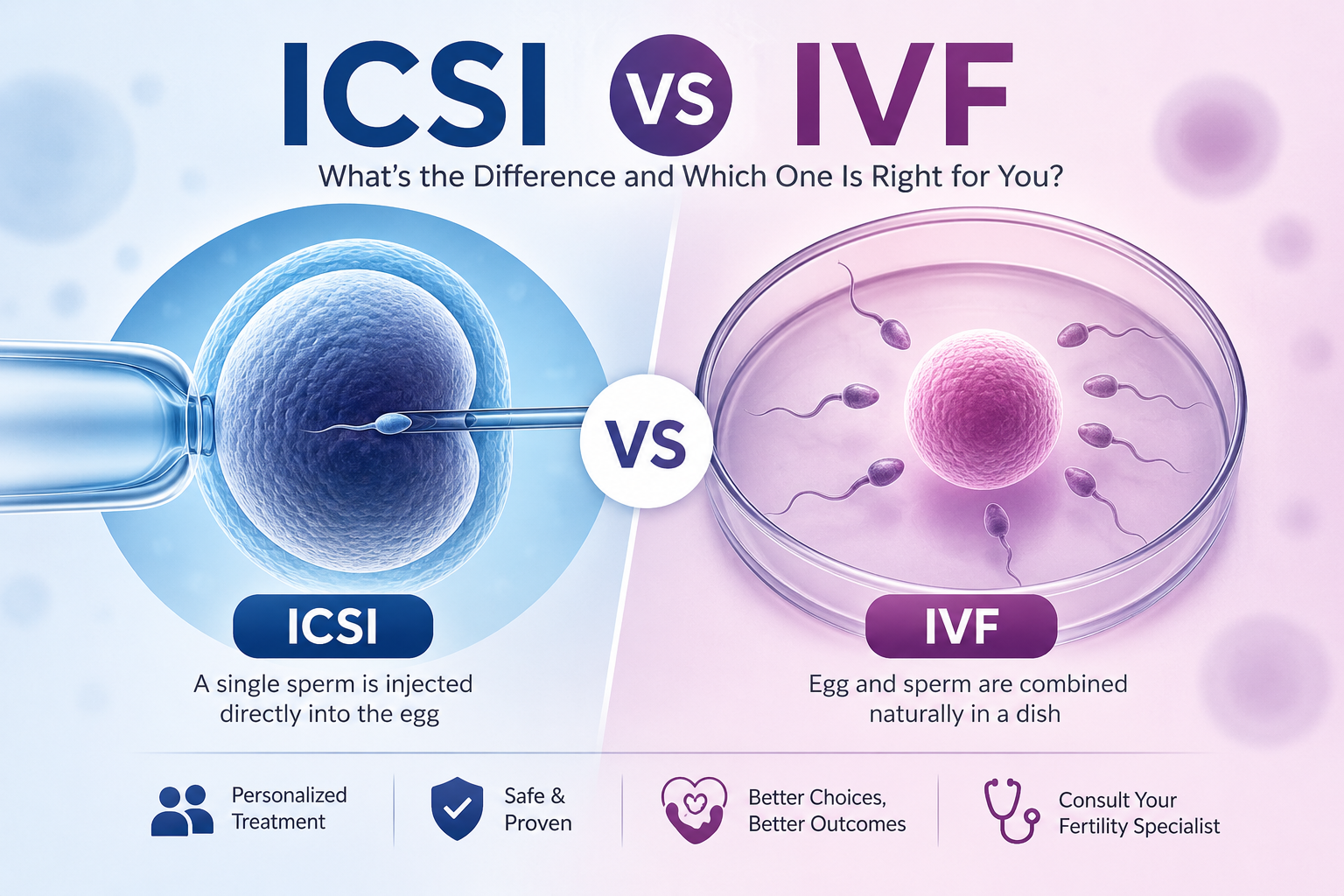
When couples begin their fertility journey, two of the most commonly recommended treatments are IVF and ICSI. While they may sound similar—and are often used together—they are actually quite different in how fertilization happens.
Let’s break it down in a simple, practical way.
What is IVF (In Vitro Fertilization)?
IVF is a process where eggs and sperm are combined outside the body in a laboratory.
How it works:
- The woman’s ovaries are stimulated to produce multiple eggs.
- Eggs are retrieved from the ovaries.
- Sperm is collected and prepared.
- Eggs and sperm are placed together in a laboratory dish.
- Fertilization happens naturally, where the sperm enters the egg on its own.
- The resulting embryo is transferred to the uterus.
Best suited for:
- Blocked fallopian tubes
- Ovulation disorders
- Unexplained infertility
- Mild male factor infertility
What is ICSI (Intracytoplasmic Sperm Injection)?
ICSI is a specialized form of IVF where a single sperm is directly injected into an egg.
How it works:
- Steps 1–3 are the same as IVF.
- A skilled embryologist selects one healthy sperm.
- The selected sperm is injected directly into the egg using a very fine needle.
- The fertilized embryo is cultured in the laboratory.
- The embryo is transferred to the uterus, similar to IVF.
Key Differences Between IVF and ICSI
| Feature | IVF | ICSI |
|---|---|---|
| Fertilization method | Natural fertilization in the laboratory | Single sperm injected directly into the egg |
| Sperm requirement | Higher number with good motility | Even a few viable sperm may be sufficient |
| Laboratory intervention | Minimal | Highly specialized |
| Cost | Generally lower | Slightly higher |
When is ICSI Recommended?
ICSI is usually advised in the following situations:
- Low sperm count (oligospermia)
- Poor sperm motility
- Abnormal sperm shape (morphology)
- Previous IVF fertilization failure
- Surgically retrieved sperm (such as TESE)
- Severe male factor infertility
Does ICSI Improve Success Rates?
This is a common misconception.
- ICSI improves fertilization rates, particularly in cases of male factor infertility.
- However, when sperm parameters are normal, ICSI has not consistently been shown to improve pregnancy or live birth rates compared with conventional IVF.
Choosing between IVF and ICSI should therefore be based on medical indications rather than assuming one is universally better than the other.
Is One Safer Than the Other?
Both IVF and ICSI are considered safe and are widely practiced around the world.
- ICSI involves more manipulation of the egg during fertilization.
- Long-term research has shown reassuring safety outcomes for children born through both IVF and ICSI.
- Overall treatment risks depend more on the patient’s individual circumstances than on the fertilization technique itself.
Which One Should You Choose?
The decision is not simply “IVF vs ICSI.” Instead, the best treatment depends on your individual fertility evaluation.
Your fertility specialist will consider factors such as:
- Sperm quality
- Age of the female partner
- Previous fertility treatment history
- Underlying cause of infertility
In many fertility centers, IVF and selective ICSI may even be combined depending on egg quality and sperm parameters.
Final Thoughts
IVF and ICSI are advanced fertility treatments that have helped millions of couples achieve parenthood. The key to success lies in selecting the most appropriate treatment based on a thorough fertility evaluation rather than following a one-size-fits-all approach.
If you are considering fertility treatment, consult an experienced fertility specialist who can guide you toward the most effective and cost-efficient option based on your unique medical needs.