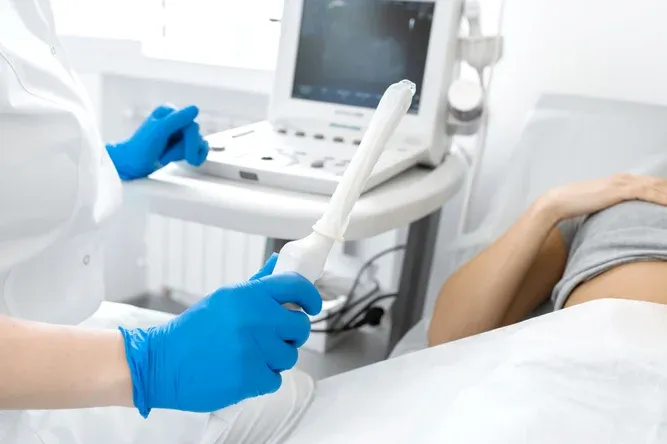
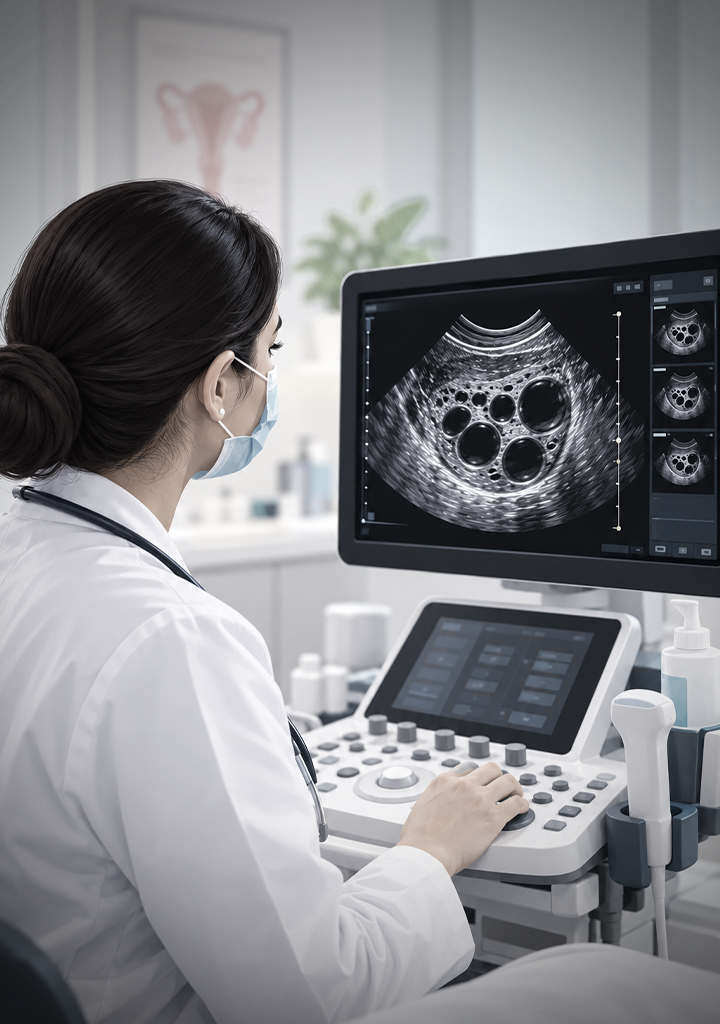
Track egg development, pinpoint your exact ovulation window, and maximize your natural or assisted chances of conception with gentle, expert ultrasound monitoring.
A Follicular Study (also known as Follicular Monitoring) is a series of painless, high-resolution transvaginal ultrasound (TVS) scans performed over a few days to track the growth and maturity of your ovarian follicles—the fluid-filled sacs that hold and release your eggs.
Instead of relying on guesswork or home ovulation kits—which can often be inaccurate for women with irregular cycles or hormonal imbalances—a follicular study provides real-time visual data on:
Identifies the precise 24–36 hour fertile peak for timed intercourse or insemination.
Assesses endometrial thickness and blood flow to ensure a healthy environment for the egg to implant.
Detects potential issues like non-rupturing follicles (LUFS), cysts, polyps, or fibroids before you waste precious cycles.

1. Initial Baseline Scan (Days 2–3 of Cycle):A quick scan to ensure your ovaries are resting without residual cysts and to establish a starting baseline.
2. Progress Scans (Days 9–14 of Cycle): Short scans performed every 2 to 3 days to measure the growing follicle size (aiming for ~18–22 mm) and uterine lining depth. 3. Trigger & Ovulation Tracking: Once the follicle reaches optimal maturity, a trigger injection may be scheduled to ensure timely egg release for natural conception or IUI.
Follicular study can be helpful for couples who have been trying to conceive for at least 6 to 12 months without success, or for those who are undergoing fertility treatments such as intrauterine insemination (IUI) or in vitro fertilization (IVF).
A follicular study usually takes about 2 to 3 weeks, depending on the length of the menstrual cycle and the rate of follicle growth.
No, a follicular study is not painful. It is a non-invasive procedure that involves only ultrasound scans and blood tests.
There are no significant risks associated with a follicular study. However, in rare cases, the ultrasound probe may cause discomfort or minor bleeding.
After a follicular study, a fertility specialist will review the results and recommend the best course of treatment based on the individual's specific needs and circumstances. This may include timed intercourse, intrauterine insemination (IUI), or in vitro fertilization (IVF).
The success rate of follicular study depends on a variety of factors, including the age and fertility of the couple, the number and quality of eggs, and the type of treatment used. Generally, the success rate of timed intercourse or IUI after a follicular study is around 10-20%, while the success rate of IVF can be as high as 40-50%.
We hope that you have found the information provided here helpful to you and we look forward to hearing from you. Please feel free to contact us for further support.